Get a Free Little Thinkers Printable Kit
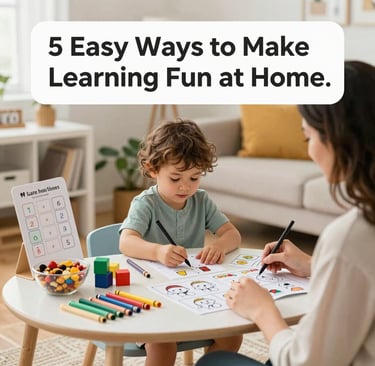
5 Easy Ways to Make Learning Fun at Home
Simple, playful ideas parents can use to turn everyday moments into learning opportunities.
5/8/20246 min read
5 Easy Ways to Make Learning Fun at Home
Simple, playful ideas parents can use to turn everyday moments into learning opportunities.
Learning does not have to feel like schoolwork, especially for toddlers and preschoolers. Young children learn best through play, movement, repetition, creativity, and real-life experiences. That means your home is already full of learning opportunities. Snack time, clean-up time, story time, bath time, and even getting ready for bed can all become simple moments for building language, confidence, fine motor skills, early math, emotional awareness, and independence.
If you are looking for fun learning at home ideas, the good news is that you do not need a complicated schedule or expensive supplies. A few printable learning activities, simple routines, and hands-on games can help your child stay curious while still enjoying childhood. These ideas are especially helpful for children ages 2+, preschoolers, early learners, homeschool families, daycare routines, and parents who want easy educational activities for kids.
1. Turn Everyday Routines Into Learning Moments
One of the easiest ways to make learning fun at home is to use the routines you already have. Children love repetition because it helps them feel secure. When you add small learning prompts to everyday routines, your child can practice important skills without feeling pressured.
During breakfast, ask your child to name colors on their plate. During clean-up time, invite them to sort toys by size, color, or type. While getting dressed, talk about weather, clothing choices, body parts, and order: socks first, shoes next, jacket last. At bedtime, ask simple questions about the day, such as “What made you happy today?” or “What was something kind you did?”
These small conversations support early childhood learning in a natural way. They help children build vocabulary, memory, sequencing skills, and emotional awareness. Routine-based learning is also helpful because it does not require a separate lesson plan. You are simply adding playful learning to moments that already happen.
Easy routine learning ideas:
Count steps while walking to the bathroom
Name colors while choosing clothes
Sort laundry by color or family member
Talk about morning, afternoon, and night
Use a visual routine chart to help your child follow daily steps
When learning is part of daily life, children begin to see that learning is not something separate from the world. It is something they do all day.
2. Use Printable Activities for Hands-On Practice
Printable learning activities are a simple way to bring structure into home learning without making it feel too formal. For young children, printables work best when they are colorful, short, and connected to hands-on play. A printable feelings chart, matching page, coloring page, recipe card, reward card, or routine chart can give your child something visual to hold, point to, color, or talk about.
For toddlers and preschoolers, printable activities can support fine motor skills, early literacy, counting, shapes, colors, problem-solving, and social emotional learning. The key is to keep the experience relaxed. A child does not need to complete every page perfectly. The goal is exposure, practice, and confidence.
For example, if you are using a printable coloring page, ask your child to choose colors, describe the picture, or tell a short story about what they are making. If you are using a feelings chart, point to different faces and ask, “Which one feels excited?” or “Which face matches how you feel right now?” If you are using a reward card, celebrate effort, kindness, listening, or trying again.
Printable activities for kids can be especially useful during quiet time, travel, restaurant waits, homeschool mornings, daycare centers, or rainy days. They give children something focused to do while still leaving room for creativity.
Helpful printable activity ideas:
Coloring pages for creativity and fine motor practice
Feelings charts for emotional learning
Routine charts for independence
Reward cards for encouragement
Recipe pages for hands-on kitchen learning
Matching games for memory and observation
A small stack of printable activities can become a flexible learning toolkit for busy families.
3. Make Snack Time Educational
Snack time is a great opportunity for hands-on learning at home. Children are naturally curious about food, textures, colors, smells, and tastes. Simple recipes and snack activities can support early math, language development, independence, and healthy habits.
You can ask your child to count banana slices, compare big and small berries, name ingredients, pour with help, stir, scoop, or describe how something tastes. Words like crunchy, smooth, sweet, cold, warm, soft, and sticky help build descriptive language. Measuring ingredients introduces early math concepts such as more, less, full, empty, half, and whole.
Kid-friendly recipe activities also help children feel included. Even if they are too young to prepare food independently, they can help with safe steps like washing fruit, placing toppings, counting crackers, or choosing between two healthy options. Always supervise food activities closely and check for allergies, choking hazards, and age-appropriate serving sizes.
Simple food learning prompts:
“How many strawberry pieces do you see?”
“Which ingredient is soft?”
“What color is the smoothie?”
“Can you put three blueberries in the bowl?”
“What should we do first, next, and last?”
Snack time learning works because it is practical. Children are not just looking at a worksheet. They are touching, smelling, tasting, counting, and talking. That kind of hands-on learning often feels more meaningful for young children.
4. Build Emotional Learning Into Play
Fun learning at home is not only about letters, numbers, and colors. Children also need help understanding feelings, calming their bodies, using words, waiting, sharing, and trying again. Social emotional learning is especially important for toddlers and preschoolers because they are still learning how to manage big feelings.
You can make emotional learning playful by using feelings charts, calm down cards, breathing prompts, role-play, and simple conversations. Ask your child to point to a feeling face or act out different emotions. Practice calm breathing when your child is already relaxed, not only when they are upset. This helps calming tools feel familiar before they are needed.
A calm down corner can also support emotional learning. It does not need to be fancy. A small basket with a feelings chart, soft pillow, breathing card, book, or quiet activity can give your child a safe place to reset with adult support.
Try simple phrases like:
“It is okay to feel upset.”
“Let’s take a slow breath together.”
“Can you show me how your body feels?”
“What would help you feel calm?”
“You can try again.”
These moments help children build self-awareness and confidence. They also teach that feelings are normal and manageable.
5. Keep Learning Playful, Short, and Positive
Young children do not need long lessons to learn. In fact, short and playful activities are usually more effective. A five-minute matching game, a quick counting activity, a coloring page, a simple recipe, or a bedtime conversation can be enough.
The goal is not to fill every day with structured educational activities. The goal is to create small, joyful learning moments your child can return to again and again. Children learn through repetition, so it is okay to reuse the same printable activity, song, routine chart, or game many times.
If your child loses interest, pause and try again later. If they use a printable in a different way than expected, let creativity lead when it is safe. If they make a mistake, treat it as part of learning. Positive encouragement helps children feel proud of their effort and more willing to try new skills.
Simple ways to keep learning positive:
Offer choices when possible
Celebrate effort, not perfection
Use short activities
Repeat favorite games
Connect learning to real life
Follow your child’s interests
Keep supplies easy to reach
When learning feels warm, playful, and low-pressure, children are more likely to stay engaged.
Final Thoughts
Making learning fun at home does not require a perfect routine or a full classroom setup. Everyday moments can become powerful learning opportunities when parents and caregivers add conversation, counting, creativity, movement, feelings practice, and hands-on play.
Whether you are using printable learning activities, routine charts, coloring pages, reward cards, calm down tools, or kid-friendly recipe pages, the most important thing is connection. Children learn best when they feel safe, encouraged, and involved.
Start small. Pick one daily routine, one printable activity, or one playful question. Over time, those small moments can help your child build early learning skills, independence, confidence, and a love of discovery.
Quick FAQ
What age are these learning activities best for?
These ideas are designed for young children ages 2+, toddlers, preschoolers, and early learners. Adult supervision is recommended.
Do I need special supplies?
No. Many activities can be done with basic household items, crayons, paper, child-safe kitchen tools, and printable learning pages.
How long should learning activities last?
For toddlers and preschoolers, short activities often work best. Five to fifteen minutes can be enough, depending on your child’s interest and energy.
Are printable activities helpful for home learning?
Yes. Printable activities can support fine motor skills, early literacy, counting, routines, creativity, and emotional learning when used in a playful, low-pressure way.
Little Thinkers
Printable learning kits, activity cards, and parent-friendly tools for playful learning at home.
Contact
Newsletter
© 2026. Little Thinkers. All rights reserved.
Digital products are delivered by email after purchase.
Questions, collaborations, or support?
Get free printables, new kit updates, and simple learning ideas for home.